The Distance Between the Red and Blue Balls at the Corners of This Cube Is
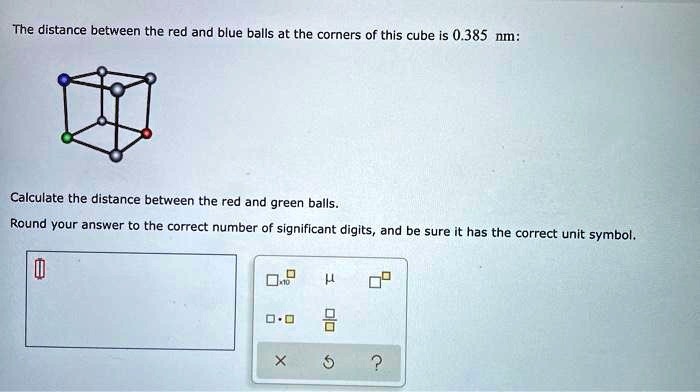
The distance between the red and blue balls at the corners of this cube Is 0.385 nm:Calculate the distance between the red and green balls_ Round vour answer to the correct number of significant digits, and be sure it has the correct unit symbol:D0.0
The distance between the red and blue balls at the corners of this cube Is 0.385 nm: Calculate the distance between the red and green balls_ Round vour answer to the correct number of significant digits, and be sure it has the correct unit symbol: D 0.0
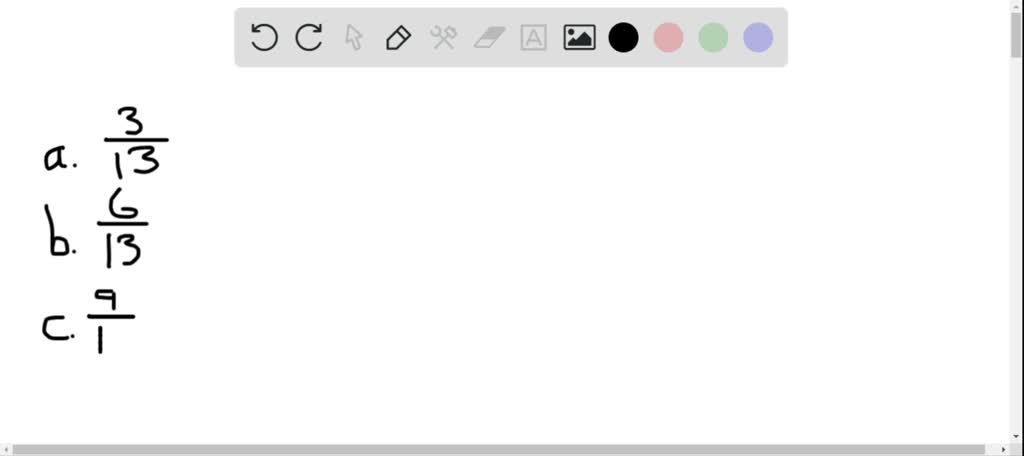
Three red balls, six blue balls, and four white balls are placed in a bag. What is the probability the first ball you draw out is a. red b. blue c. not white d. purple e. red or white f. red and white
We have 1000. Number 72. Okay, problem number 72 question says that a bag has four blue five green. So there is for green for blue and five green green file And three Red Balls. Read three balls and a ball is drawn. Its color is noted and is kept inside kept aside. Okay, three such drawers are made. The probability that a third ball drawn agent rate. So we have to uh go like this. B we'll be using B for blue, G. For green, R. For red. So required probability will be blue blue Read either to Blue one. Red place G. D. R. Bless B. three balls are red. Right? Glass. We are blessed. Priority of R. B. R. Bless G. R. R plus R. Gr Bless B. G. R plus G. P. R. So these are the priorities. Okay, so There are through four blue balls, five green balls. So priority of blue Blue are so this will be four x 12. Total number of balls total number of balls is 53 fold that is 12 balls. So four by 12 In 2, 3 x 11 in 2, 3 x 10. Because if one ball is being drawn, that is not going to be inside this bag. That's where one ball bill Be decreased. five x 12 into four x 11 Into three x 10. Bless mm 20 by 10 Plus three by 12 Into two x 11 into one x 10. Place four by 12 into three x 11 to two x 10 Plus three by 12 into four x 11 into two by 10 Plus five by 12 Into three x 11 into two x 10. Place three by 12 into five x 11 into two by 10 Plus four by 12 into fight by 11 and two, three by 10. It was five x 12 into Fall by 11 in 2, 3 x 10. These are the uh terms, so three is everywhere. So trick would be taken as common and 10 into 11-12 will be taken as common. So we'll be we'll be having 12 plus 20 plus two plus eight plus eight plus 10 plus 10 Plus 20 plus 20 10, 11, 12, 10, 11 and 12. So 5 to 6 20. So this will be one x 4. So priority must be one by four. Option # D is the correct one. Thank you.
Same bags, the previous problem. But now we have a different We're drawing two balls, because it probably that we draw first red and then blue. Well, there are three out of 13 red. Okay, so we're not putting that red one bag. So our next one that we're gonna draw these are blues who have six blue balls. But now there's only 12 to draw from. And so that reduces to 1/2. Yes, there are final probability of that happening is three out of 26 can be is first blue and then red. So first, we have six out of 13 and then we have three out of 12. Three of the total reduces to 1/4. Ah, actually, we can reduce the 6 12 So was still get three out of 26. Okay, See, is that both balls drawn or white? So we're gonna have four out of 13 times three out of 12 because we have one less white ball to draw from. Case of the four reduces with 12 making it 1/3. That's just gonna be in the 3/3 is cancel. So it's just going to have one in 13 chance de is first blue and then second, not bread. Okay, so the 1st 1 being blue is six out of 13 and of the ones that are left, there are only five blue left. And for whites, that's gonna be nine out of 12. Okay, so six and 12 reduced to 1/2. That's just gonna be nine out of 13 out of 26. Not have 26. Okay, first white second, not blue. So we're gonna four out of 13. And then now there's only 12 balls left. We've pulled one of the whites out, so we're down to six balls that are not blue. So it's just gonna be four out of 26 which reduces to two out of 13. First not read. It should not be read. That would be 10 out of 13 from the second. Not too blue. Ah, interesting. So there's two ways this can happen first, not bread second, not blue. Okay, so the options for this are blue or why? And then once we get in the blue, it could be white or ren. And once we get the white, it can be white or red. Okay, so there's two. There's two ways to do this. So I'm not to calculate both these probabilities and then add them. Okay, so the probability of getting blue first would be six out of 13. And since we drew a blue out, Um, and we did not change the white or the red. We're gonna have 7/12 left que the six in the 12 cancel toe 1/2 so it would be 7/26. Then we're gonna add to that the white drawn first. So the white drawn first would be four out of 13. And since now that there's a white gone, it will be six out of 12 that are left that could be white or red Can that's gonna be four out of 26. It's just something this together will have a total of 11 out of 26 would be the probability of this happening. It was an interesting one to work out. Okay, thank you very much.
Okay, so we've got a jar that contains three red bulls in five white balls, and we're picking too cooking, too. And so for a were saying was the probability that we get to red balls. So then for doing two red balls, But we're gonna choose our 1st 1 So we've got the probability of three out of the eight this 1st 1 So this is picking our first ball. And so now we have two red balls left out of seven. So we've decreased our sample size inner that size so again, and that's that. So now we'll get this three. It's time to seventh, John. Go ahead. Simple high. This will get four to leave us with three over 28. So that's the probability that we get to red balls now for B for two white balls will be kind of using the same thing. Will have five over eight for the first woman, which is pretty simple. And it will multiply it by the chance of getting one with white balls from the remaining seven himself, doing the same kind of thing here one. So we'll end up with 17th for this one, which cannot be right. This should have been one this should Then, too. And then that would have been We've been 5/14 which is by far, much more correct. So I was able to tell that there was something wrong with that problem because I had a probability of something happening greater than one, which should never happen. If you have probably greater than one. That's a sure sign that you've done something wrong. So thanks to that, I was able to catch a mistake right there.
Given an end containing 15 balls, that is five red, six green and for white, What is the probability of getting a red ball? So we know already that our sample spaces 15 in the successful outcome is to get red balls and we've got five of them. So this will simplify to 1/3, but what are the odds of getting a rent? So the odds of getting a red bow are equal to the successful, but it's a ratio of the successful outcomes and the unsuccessful outcomes. So it's 1/3, s two to over three, which will multiply 2, 3/2, this is equal to 1/2 or half. Um We also have to file the probability of getting drained balls, I've got six of them Out of the sample space, which is 15. And if we simplify this, it will give us 2/5. Now, what are the odds good to meet you? Successful Outcomes, which is 2-5, multiplied by uh the envious of the, I'm successful outcomes, which is five over three. And this will give us, I'm sorry, this will give us to over three. And the probability of getting either red or green. And we have got 12345678 1911. We've got 11 out of 15. So what are the odds of getting a red or grey? This is it was too successful outcomes, which is 11 of 15, multiplied by unsuccessful injuries. Of the unsuccessful outcomes which use 15 over four. So this will give us 11 over four.
5 answers
Consider the WaVC equationUttc?Aufor a circular membrane of radius 4, centered at the origin:By using the change of variables (€,y) = cos 0," sin 0) , show that the Laplacian 4 0r2 is transformed to02 1 02 40 dr2 72 092 b) Using separation of variables solve the wave equation for u(r; 0,t) under the Dirichlet boundary condition u(a,0,t) 0 (note also that physically wC require |u(0, 0,t)| < x) and initial conditions u(r, 0,0) = 0 and &t(r; 0,0) = f(r) sin(20)
Consider the WaVC equation Utt c?Au for a circular membrane of radius 4, centered at the origin: By using the change of variables (€,y) = cos 0," sin 0) , show that the Laplacian 4 0r2 is transformed to 02 1 02 40 dr2 72 092 b) Using separation of variables solve the wave equation for u(r...
Source: https://itprospt.com/num/6061803/the-distance-between-the-red-and-blue-balls-at-the-corners
0 Response to "The Distance Between the Red and Blue Balls at the Corners of This Cube Is"
Yorum Gönder